
First response time is one of the most commonly measured KPIs in customer support. In 2026, 90% of shoppers say immediate responses are critical, and 60% of customers won't wait longer than 10 minutes before they click away to a competitor. Businesses that invest in customer satisfaction through faster response times see better retention, stronger brand loyalty, and fewer missed opportunities. This post breaks down what first response time is, how to calculate it, and how AI chatbots are changing the game for good.
What Is First Response Time (FRT)?
First response time, often called FRT or first reply time, is a metric that measures the elapsed time between ticket creation and the first meaningful agent response. The clock starts the moment a customer submits a request, whether that's a support ticket, an email, a live chat message, or a social media comment. It stops the moment a service agent, or in some cases a well-built response system, sends a real reply that addresses the customer's query or concern.
You can think of first response time as a metaphorical timer running the second a customer reaches out. A brief automated notification or auto-responder confirming receipt usually doesn't count. What matters is the first human reply, or a true first meaningful response, that shows someone or something takes ownership of the request. First response time applies across every channel and segment, including email, live chat, and social media. For B2B and consumer businesses alike, first response time is treated as a crucial metric because it's often the customer's very first impression of your customer experience, or CX. Companies that fall behind competition on this number tend to see it show up later in resolution time, average handle time, and overall customer satisfaction.
First Response Time vs Resolution Time
It helps to separate first response time from resolution time. First response time only measures how quickly an agent first responds, not how long it takes to fully resolve the issue. A business can have a fast FRT and still take longer to fully resolve issues. That said, faster FRTs often lead to smoother resolution overall, since the customer knows their issue is being looked into from the start.
Why First Response Time Matters
There is a direct correlation between response speed and customer satisfaction, or CSAT. When customers wait in queues too long, they start to question whether their request was even received. A quick, helpful reply, even a short one, reassures them they're on the right track and that someone is ready to help.
This is why first response time is often considered more important than overall reply times. A comprehensive answer that arrives late does less for customer satisfaction than a brief reply that arrives fast and confirms the issue is being looked into. Rushing replies just to hit a number isn't the goal either. The Goldilocks Zone is a balanced FRT target that feels fast without sacrificing quality of responses.
Different support channels carry different expectations. Live chat customers expect near-instant replies, while email allows more breathing room. Industry benchmarks shift over time too, so tracking the trend, whether it's increasing or decreasing over a given period, tells you if agents are struggling or if your workflow is slowing down.
In fast-paced e-commerce specifically, first response time plays a crucial role in whether a shopper completes a purchase. Slow first response can boost cart abandonment, while lightning-fast, prompt support can boost sales and build long-term brand loyalty. This is also a leading indicator of service quality, brand perception, and operational efficiency company-wide, which is why it factors into staffing models, channel strategy, and automation investments.
How to Calculate First Response Time
The standard formula for calculating average first response time is simple. Take the total first reply time across all tickets, then divide by the number of resolved tickets in a given period, whether that's an hour, a day, a week, or longer. For example, if you have three FRTs of five minutes and one FRT of one minute, the average comes out to four minutes. But the median in that same dataset would be five minutes. Averages can be skewed by outliers, so many teams use the median instead of the average for a more accurate representation of typical performance.
Business hours matter here too. If a customer submits a request at 4:58 p.m. on Friday and an agent responds at 10:03 a.m. On Monday, most businesses exclude the weekend from that calculation since they were closed. This is sometimes called a follow-the-sun model, where off hours don't count against your FRT. Most modern ticketing systems can automatically calculate this using the timestamp of the first reply minus the ticket creation timestamp, using either calendar-hours or business-hours calculations. It's also common practice to exclude automated responses, chatbots, and virtual assistants from these numbers unless bot performance is being measured separately, since exclude auto-acknowledgements and bot replies keeps the human side of the metric clean.
For a deeper look, percentile metrics like p50, p75, and p90 often tell you more than a single average FRT number, since they show you the tails of your distribution, not just the middle.
Four Ways to Measure First Reply Time
There are a few reliable ways to measure first reply time accurately, and getting this right matters just as much as improving the number itself.
First, always define whether you're measuring in business hours or off hours, and communicate business hours clearly to your team so everyone is working from the same standard.
Second, take the median, not the average, when reporting FRT, since this controls for outliers and complexity of issue. A chat resolved under a minute and an email assigned to the wrong team member can both distort a simple average into an inaccurate FRT picture.
Third, track FRT in your service reports as one of your core KPIs, or key performance indicators. This turns raw numbers into actionable insights instead of just data sitting in a dashboard.
Fourth, automatically measure FRT through your customer service software wherever possible. This helps eliminate manual errors and keeps your first response time for customer service reporting consistent across every response system.
Many businesses also use service level agreements, or SLAs, as a baseline. These are written agreements that set a standard for customer support performance within a specified timeframe, creating accountability across the team.
Customer Response Time Expectations and Industry Benchmarks
Response time metrics vary by channel, and each one comes with its own baseline. Here's a general breakdown of good, better, and best for 2026:
|
Channel |
Good |
Better |
Best |
|
Live chat |
1 minute or less |
40 seconds or less |
Under 20 seconds |
|
|
12 hours or less |
4 hours or less |
1 hour or less |
|
Social media |
5 hours or less |
2 hours or less |
1 hour or less |
|
Phone |
About 1 minute |
30 seconds ASA |
Under 15 seconds |
These benchmarks shift depending on industry, team structure, and account complexity. B2B enterprise SaaS companies often set platinum or tier-1 targets of 15 to 30 minutes, with a standard tier closer to 1 to 4 hours. E-commerce and retail businesses tend to aim for email replies within 2 to 12 hours, with seasonal swings during busy periods, and live chat under 60 seconds. Telecom and ISP support teams often target an average speed of answer, or ASA, under 30 seconds for priority queues.
Roughly 90% of U.S. customers prioritize immediate responses, and nearly 75% expect a reply within 24 hours across most channels. On social platforms specifically, Facebook Messenger sees an average response window of around 4 hours 30 minutes, while Instagram DMs run closer to 7 hours, which is why many teams aim for 15 minutes on social media as a stronger, more competitive target.
How to Improve and Reduce First Response Time
Lowering your average first response time takes a mix of training, technology, and smart workflow design. Here are the strategies that consistently move the needle.
- Train agents on product knowledge and company policies. Efficient workers who know your best practices spend less time searching and more time resolving issues. Role-playing exercises and consistent product training have helped teams slash response times by up to 30%.
- Build a robust knowledge base. An internal knowledge base with product specs and customer account details reduces time spent searching. An external, self-serve knowledge base can also lead to a reduction in help tickets overall, since customers can resolve common issues on their own.
- Use strategic AI and automation integration. This is where AI chatbots earn their place. Automation can route issues to appropriate agents, identify intent automatically instead of relying on manual triage, and use canned responses as a first draft that an agent can quickly review and send. Centralizing queries through automation has helped some teams reduce response times by 60%.
- Set clear team FRT goals. Data-driven, industry benchmark goals give your team something concrete to aim for. Gamifying performance with point systems and leaderboards can create healthy competition and keep agents motivated.
- Assign ownership before the first reply. A shared inbox with clear rules for routing work cuts down on handoffs. Whether it's a general question or something more technical, routing automatically based on context, not manual triage, keeps things moving.
- Track performance across channels. Real-time monitoring and smart ticket prioritization help you catch delays early, so bottlenecks and inefficiencies get fixed before they hurt your response quality and speed.
Ready To Turn Conversations Into Customers?
Launch a no-code AI chatbot that answers questions, captures leads, and helps your business grow 24/7.
Start Your Chatbot FreeWhy First Response Time Runs High
When FRT climbs, it's usually not about one person underperforming. It's more often a sign of operational friction and system design gaps. Fragmented tools, unclear ownership over who owns the ticket, and messy handoffs all add coordination overhead. One widely cited figure suggests teams can spend nearly 3 hours on coordination for every 1 hour actually spent solving a customer's problem.
Manual triage and slow intake create prioritization delays, especially when urgent issues sit in the queue waiting for someone to notice them. Agents reviewing each message from scratch, often pulling customer history from three different systems, spend more time assembling context before drafting a reply than actually answering the question. These are process failures, not individual performance failures, and they call for better structure, not just faster typing.
How AI Chatbots Directly Lower First Response Time
This is exactly where an AI chatbot changes the math. A chatbot removes the biggest source of delay, which is availability. Instead of a customer submitting a request and waiting for the next available agent, an AI chatbot can respond the instant a message comes in, 24/7, across nights, weekends, and business hours alike.
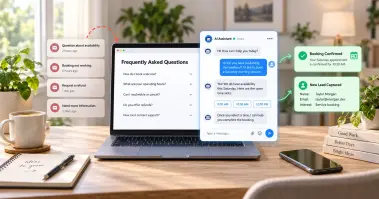
PerfectCSR is built around exactly this problem. It's trained on your own website, files, and videos, then goes live on your site in under 10 minutes, with no code and no complex setup. Once live, it answers customer questions, captures leads, books appointments, and hands off to your team the moment a human touch is needed.
For a healthcare clinic, that could mean answering a question about clinic hours, booking an appointment, or routing an urgent query to staff at midnight, all without a patient waiting until the office reopens. PerfectCSR does not provide health information itself. It handles scheduling, booking, and routing, so real staff can focus on the parts of care that actually need a human.
You can start your free trial today. No credit card required, and you can cancel anytime.
Features Built for Speed and Consistency
PerfectCSR includes several features built around speed and consistency. Visual Funnels give you shortcuts to guide a conversation toward resolution. Custom Response Skills let you tailor replies to your business and brand voice. Lead generation forms capture every visitor worth following up with. Team management with multi-level user integration keeps handoffs clean when a real agent needs to take over. Continuous learning reviews unresolved chat logs to keep improving accuracy. Real-time analytics let you track first response time and other performance data as it happens.
You can also choose a persona that fits your business. A support agent persona stays patient and focused on getting the customer to a resolution. A sales assistant persona is upbeat and built to move a conversation toward a decision. A lead generator persona asks the right questions and captures every visitor worth following up with. A technical support persona is precise and walks customers through a fix step by step. Or you can build a new custom persona entirely from scratch.
Common Challenges and Their Solutions
Most businesses run into the same handful of problems when trying to lower first response time.
- Overwhelming ticket volumes. During peak periods, a small team can fall behind fast. An AI chatbot can absorb high ticket volume by handling common questions instantly, freeing up human agents for complex inquiries.
- Gaps in agent training. Inconsistent response quality often comes down to knowledge retention gaps. A chatbot trained directly on your own content gives the same accurate answer every time, without needing retraining for every new hire.
- Technical hurdles connecting platforms. Disconnected channels and fragmented customer data slow everyone down. Centralized customer service software that integrates channels under one roof solves this by keeping communication in a single place.
- Off-hours coverage gaps. Customers don't only reach out during business hours. An AI chatbot fills nights and weekends automatically, so first response time customer service stays consistent no matter when someone reaches out.
Key Performance Indicators for Response Time Success
Response time management depends on tracking the right KPIs. Average first response time across all customer inquiry channels is the core number, but it shouldn't stand alone. Pair it with Service Level Agreement compliance rates for accountability and customer satisfaction scores to confirm that response speed is actually translating into a better experience.
Comparing response times across channels also helps with resource allocation. If social media response rates lag behind live chat, that's a signal to adjust staffing levels or lean more heavily on automation during peak inquiry periods. Consistent performance over time, not just a single good week, is what actually builds trust and repeat business.
Real-World Examples of Successful FRT Strategies
Leading companies in the e-commerce landscape have found real success by combining smart automation with strong internal processes. Some have achieved FRT under one minute by empowering their support team with decision-making authority and thorough training. Others have built omnichannel support systems paired with an extensive knowledge base, giving agents quick access to information and pushing their average FRT under 15 minutes.
AI automating routine inquiries has become one of the most common threads across these examples. By letting a chatbot handle repetitive questions, teams free up agents for issues that genuinely need a human. Combined with real-time monitoring and smart ticket prioritization for urgent issues, some businesses have managed to cut FRT by 30% while centralizing customer communications across every channel.
Don't Stress Speed Over Satisfaction
Even with all this focus on speed, first response time should never come at the expense of quality. The goal isn't to fire off the fastest possible reply. It's to be both faster and more accurate, so customers get real help, not just a quick acknowledgment. When it comes to FRT objectives, businesses that manage to achieve both speed and satisfaction end up as a genuinely valuable partner in the eyes of their customers, not just a fast one.
Stop Losing Customers to Slow Replies
First response time is a crucial metric for any business that depends on customer inquiries, whether that's a retail store, a B2B service, or a healthcare clinic. Faster, more consistent first response times build trust, boost customer satisfaction, and protect your bottom line. AI chatbots have become one of the most reliable ways to close the gap, since they never sleep and never leave a customer waiting in the queue.
If you're ready to lower your first response time without adding more work for your team, PerfectCSR can help. It answers questions, books appointments, captures leads, and hands off to a real person the moment a human touch is needed, day and night. You can start your free trial now. No credit card required, and you can cancel anytime.
Ready To Turn Conversations Into Customers?
Launch a no-code AI chatbot that answers questions, captures leads, and helps your business grow 24/7.
Start Your Chatbot FreeFAQs
How does first response time affect customer retention?
A fast FRT shows customers that you value their time. This builds trust from the very first message and boosts customer retention, as long as the quick reply is backed up with real follow-through. PerfectCSR helps here by replying instantly and handing off to your team the moment fast issue resolution requires a human touch.
How do you set FRT targets by account tier?
Most businesses use three tiers based on customer size and strategic importance. Tier 1 accounts usually need the fastest response time, and PerfectCSR's 24/7 availability makes it easier to consistently sustain that speed. Tiers 2 and 3 can use more modest targets that align with industry benchmarks while still getting a fast first reply through the chatbot.
What tools help reduce first response time?
An AI-powered, multi-channel customer service platform is one of the most effective tools available. PerfectCSR automates workflows, centralizes communication across your site, and improves coordination across teams by routing conversations to the right person the moment a handoff is needed.
How can response time be improved?
Integrating chatbots for instant answers to common questions is one of the fastest ways to improve response time. PerfectCSR handles automated responses through streamlined communication on efficient channels like live chat, while staff training helps your team stay ready for complex inquiries. Tracking performance metrics and customer feedback also helps you identify bottlenecks over time.
How can customer service response times be improved?
Automation tools that deliver instant responses go a long way toward improving efficient workflows. PerfectCSR can route inquiries automatically and pull from a thorough knowledge base for quick reference, while ongoing staff training covers what the chatbot hands off. Monitoring performance metrics and gathering customer feedback also helps identify pain points and areas for improvement.
What is a good first response time?
A good first response time varies by channel and follows industry-specific standards. As a general guide, emails should be answered within an hour, up to 24 hours at most, social media within 15 minutes or less, SMS within 40 seconds, and live chat under a minute.