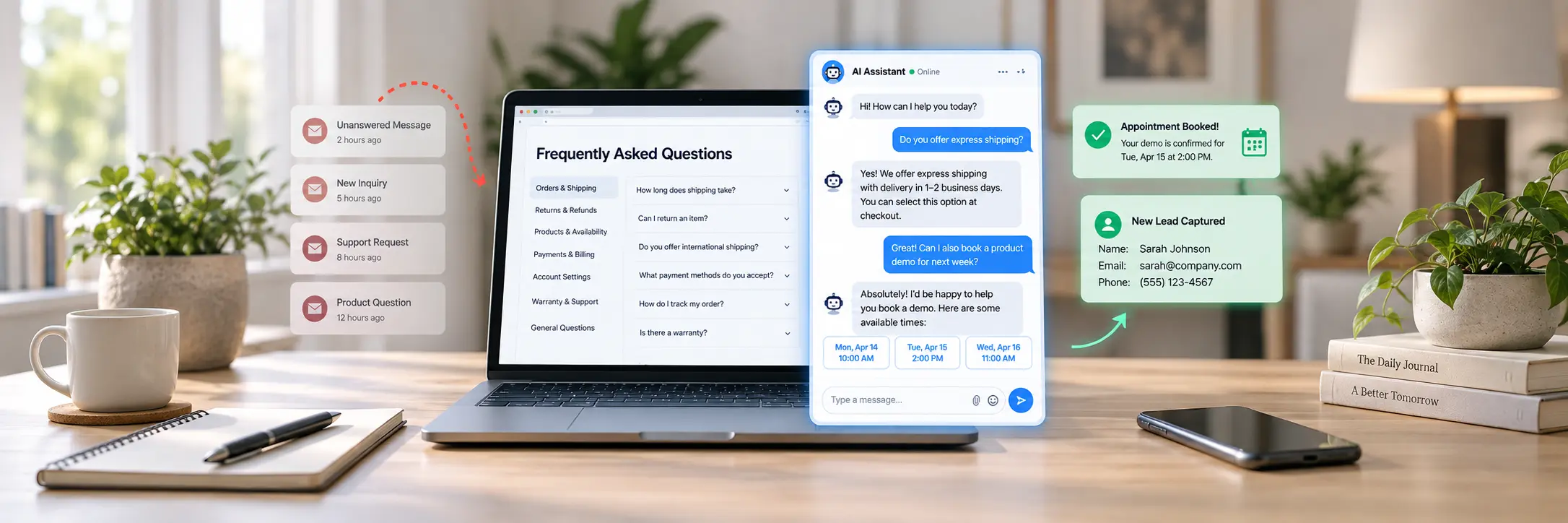
Is your FAQ page not reducing support tickets, even after months of updates? If so, you are definitely not alone in this. Research shows 61% of customers actually prefer to solve simple issues themselves rather than reach out to you. Yet one major study found that only 14% of self-service attempts actually manage to resolve the problem. So your team ends up spending hours writing clear answers, and tickets barely drop anyway. The truth is, this was never really a writing problem to begin with. It is a structural one instead. In this post, we will break down why your FAQ page is not reducing support tickets and why an AI agent actually works instead.
You've Probably Tried This Already
You built an FAQ page and wrote clear, thoughtful answers for it. You organized everything logically, maybe even added a search bar because why not? And for a while, it actually looked like it was working. Ticket volume dropped a little, then just... stopped. Flatlined. So your team went back in and rewrote the whole thing. Shorter answers this time, snappier categories, thinking surely that would do it.
But the same customers kept asking the exact same questions your FAQ was already answering. Frustrating, right?
Here's the part that really stings. Customers are not trying to be difficult. They genuinely want to help themselves and would rather not deal with you at all if they can avoid it, no offense. One industry report found that 81% of customers actively want more self-service options. So the willingness is there. It's just not translating into results, and that gap is exactly what your team needs to close.
The Belief That's Holding You Back
Most support teams believe something like this: "If our FAQ isn't cutting tickets, we need better content. Clearer answers. Better organization. Smarter search. The problem is execution, not the approach."
This belief is wrong, and most businesses are unfortunately unaware of that. Not because content quality doesn't matter, a well-organized FAQ will always beat a messy one, but because content improvements typically move resolution rates by single digits. The gap between a mediocre FAQ and an excellent one might be 12% resolution versus 18%. Neither touches the majority of attempts that still fail.
The bottleneck isn't content. It's structural. An FAQ can only give information, and most customer questions are actually requests for something to happen. A visitor asking about your availability doesn't want a paragraph about your hours. They want a slot booked. Information doesn't resolve action.
10 Real Reasons Your FAQ Page Is Not Reducing Support Tickets
You built the page with good intentions. You wrote clear answers and organized them the best way you knew how. But somewhere between publishing it and watching your ticket count, something didn't add up.
1. Customers Don't Search the Way You Write
You titled a section "Service Availability and Scheduling Windows." Your customer types, "When can someone come by?" These two phrases share almost no words. A recent survey found that a large share of self-service users said the company simply didn't understand what they were trying to do. The content exists, and it just does not speak the customer's language.
One online support forum discussion pointed out that customers repeat the same questions because they simply don't find the answer where they expect it, even when it's technically on the page somewhere.
2. FAQ Pages Can't Ask Follow-Up Questions
A static page gives one answer to everyone. Real questions depend on context. "Can I book this week?" depends on your schedule, your service type, and your team's availability. A person can ask a follow-up, but a page cannot. That gap between a help page and an actual conversation is where most of your lost tickets live.
3. FAQs Go Out of Date Fast
Business hours change. Services get added or dropped. Pricing shifts. Your FAQ page often does not keep up. Wrong information creates a worse experience than no information, because now your team has to correct a mistake before even solving the real problem. And as one customer experience discussion pointed out, inconsistent answers across channels is one of the biggest behind-the-scenes headaches support teams deal with.
4. Most Questions Are Requests, Not Curiosity
This is the biggest one. Most visitors are not browsing for fun. They want something to happen. Customers prefer getting a callback, a booking, or a real answer about your service right now. A FAQ page can explain your process. It cannot move someone through it.
5. There's No Owner for FAQ Maintenance
Ask who is responsible for updating your help page. Often, nobody clearly owns it, as support handles tickets and marketing owns the website. Nobody circles back to fix outdated answers. Over time, the page becomes a mix of old policies and half-true information nobody remembers to fix.
6. Customers Want to Feel Heard, Not Redirected
A frustrated visitor does not want to be sent to a wall of text. They want a response to their specific situation. Static pages treat everyone the same, which is exactly the complaint raised repeatedly in customer service discussions: being told to "check the FAQ" feels dismissive when the situation is even slightly different from the example listed.
7. FAQs Don't Qualify or Capture Leads
Every visitor who reads your FAQ page and leaves unanswered is a missed opportunity. A good FAQ answers a question. It does nothing to capture that person's contact details or move them closer to becoming a customer. For a growing business, that gap adds up fast.
8. Mobile Users Skip Long Pages
Most visitors browse on their phones. Long FAQ pages with dozens of dropdowns are hard to scroll through on a small screen. People give up halfway and pick up the phone instead, which adds to your support load rather than reducing it.
9. FAQs Can't Personalize Based on Who's Asking
A returning customer and a first-time visitor often need different answers to the same question. Your FAQ page treats them identically. It has no memory, no history, and no way to adjust the response based on who is asking.
10. There's No Clear Next Step
Many FAQ answers end with information and nothing else. A visitor reads the answer and still doesn't know what to do. Call? Email? Book something? Without a clear next step, that visitor becomes a ticket anyway.
Want to see exactly where your FAQ page is losing people? Start your free trial and let PerfectCSR show you what your customers are really asking.
The Four Structural Failures Behind a Weak FAQ
Once you stop blaming your writing, four structural problems come into focus.
- Language gap: You organize content by internal categories, like services or scheduling. Customers organize problems by how they feel and what they need right now. That mismatch cannot be fixed with better synonyms alone.
- Context void: A static page gives the same generic answer to everyone, because there is no session, no back-and-forth, and no way to ask a clarifying question. A human would say, "Let me check that for you." A page just repeats the same paragraph.
- Decay problem: FAQ maintenance has no clear owner, so pages quietly go stale while the business keeps moving.
- Action barrier: Most inquiries are requests to make something happen, not requests to understand how something works. A page can explain. It cannot act.
What Actually Works Instead of a Static FAQ Page
Move From Information to Conversation
A page can only explain. A conversation can guide. That is the shift smart businesses are making now. Instead of hoping visitors find the right paragraph, they use AI chat systems that respond directly, ask clarifying questions, and guide the visitor toward a resolution in real time.
Use AI That Understands Intent, Not Just Keywords
Traditional FAQ search works on keyword matching. If the words don't line up, nothing useful shows up. AI-powered systems work differently. They read meaning, not just text. So when a visitor types "can someone call me back today," the system understands the intent behind it and responds accordingly, instead of returning a generic page about "contact options."
Capture the Visitor Before They Leave
This is where most FAQ pages fail completely. They answer a question, and the visitor closes the tab. A smarter approach captures that visitor's details while helping them, so even if they are not ready to commit today, you have a way to follow up. Case studies show meaningful ticket reductions for businesses that pair static content with AI-powered support.
Curious how this looks for your business? See PerfectCSR in action and turn your visitors into real conversations.
How to Tell If This Is Your Problem
Try this exercise. Pull 100 recent conversations or missed inquiries and sort them into two buckets:
Information requests. The visitor needed an answer. "Do you offer this service?" "What are your hours?" "How does this work?" Content could theoretically resolve these.
Action requests. The visitor needed something done. "Can you book me in this week?" "Can someone call me back?" "I need a quote now." These need a real response system, not more paragraphs.
If action requests make up half your volume or more, your FAQ page was never going to fix the problem. No amount of rewriting closes that gap. What closes it is a system that can respond and act, not just display text.
Where an FAQ Page Still Helps?
To be fair, an FAQ page is not useless. It gives visitors a first stop for simple, unchanging information and sets expectations before a conversation even starts. But it works best as a foundation, not the entire support system. Businesses that pair a basic FAQ with a responsive AI chat layer see the biggest shift in ticket volume, because visitors get a real answer instead of a wall of static text.
Where PerfectCSR Fits In
PerfectCSR is built to pick up exactly where your FAQ page runs out of road. It trains on your own website, files, and videos, then goes live on your site in one hour tops. It answers questions the way a real conversation would, captures leads through a built-in lead form, books appointments directly, and hands off to your team the moment a human touch is needed. You can shape how it sounds too: patient and resolution-focused for support, upbeat and persuasive for sales, or a fully custom voice built from scratch. Every conversation feeds its continuous learning, so it gets sharper over time instead of sitting still like a page nobody updates.
Ready to give your visitors a real answer instead of another paragraph? Enter your email and start your free trial. No credit card required, and you can cancel anytime.
Stop Editing the Page & Fix the System
If your FAQ page is not reducing support tickets, the page itself is probably not the problem here. The real issue is that most of your visitors need action, not information, and a static page was simply never built to deliver that. Businesses everywhere are moving past the FAQ-only model and adopting AI agents that talk, capture, and book in real time instead. Your competitors may already be making that shift, whether you have noticed it yet or not. The longer your team relies on a page alone, the more visitors you are likely losing to a competitor who responds faster.
That is exactly the gap PerfectCSR is built to close for you. Start your free trial and give every visitor a real answer, not just another page to skim and leave.
Ready To Turn Conversations Into Customers?
Launch a no-code AI Agent that answers questions, captures leads, and helps your business grow 24/7.
Start Your Ai Agent FreeFAQs
1. Why do customers still contact support after reading the FAQ page?
Because most FAQ pages only explain a process. They cannot complete an action, like booking a slot or confirming availability, so the visitor still has to reach out to get it done.
2. How do I reduce support tickets without hiring more staff?
The fastest way is to automate the repetitive, high-volume questions with an AI agent that can respond instantly and hand off only the complex conversations to your team.
3. What is the difference between a chatbot and an AI customer support agent?
A basic chatbot follows fixed scripts and struggles outside them. An AI agent like PerfectCSR understands intent, answers naturally, captures leads, and books appointments without needing an exact keyword match.
4. Can AI actually handle customer support instead of a human?
Yes, for most repetitive requests. AI agents handle round-the-clock questions, lead capture, and appointment booking, then escalate to a human the moment a conversation needs a personal touch.
5. How long does it take to set up an AI chatbot for a website?
With PerfectCSR, it takes about an hour. It trains directly on your existing website, files, and voice notes, so there is no complex setup or coding required.