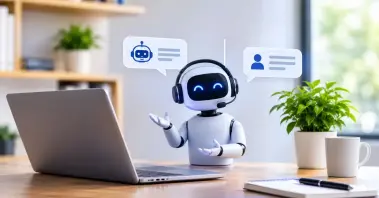

In a fast-paced digital world, customers expect more than fast responses—they want warmth, relevance, and contextual understanding. Modern conversational AI has evolved beyond scripted replies. Today’s advanced AI chatbots understand the intention, tone, and history behind each message to create genuine, human-like interactions. Brands that deploy empathetic AI agents stand out. They build trust, reduce friction, and foster stronger customer loyalty.
From Scripts to Empathy: The Rise of Emotionally Intelligent AI Agents
The next generation of AI agents is not built on pre-written scripts alone. Instead, they’re designed to understand the emotions, context, and intent behind user interactions. Traditional bots could answer basic queries, but they often lacked the ability to adapt tone, express empathy, or respond thoughtfully to emotional cues. Today, emotionally intelligent AI is reshaping customer service by offering responses that mirror human understanding.
These agents are driven by natural language processing (NLP), sentiment analysis, and machine learning. These enable them to recognize frustration, excitement, perplexity, or urgency in a customer's tone and respond accordingly. From a refund request to a complaint about a bill, human-like AI agents can de-escalate tension, respond in the right way, and hand over the conversation to a human as and when required.
For businesses, this means higher customer satisfaction, lower churn, and a brand experience that feels more personal, even when automated. Empathetic AI isn’t just about smarter responses; it’s about building relationships that feel real and respectful, even through a screen.
Conversations That Click: How Human-Like AI Boosts Customer Loyalty
Customer support is no longer just about resolving tickets—it’s about creating memorable experiences. AI agents that feel human make conversations feel natural, helpful, and personal, which strengthens trust and encourages return visits. When customers feel heard and understood, they’re more likely to stay loyal to the brand.
Consistency of tone, quickness of response, and correctness of resolution all make for good engagement. Additionally, AI does not rest, which is to say that your brand is available 24/7, without the typical overhead. The best agents even recall preferences, previous problems, or order history, making for effortless and customized experiences over time.
In competitive markets, these nuances are what set brands apart. Consumers don't want answers—they want to be understood. When AI conversations feel natural, they become repeat shoppers.
The Digital Face of Your Brand: Making AI Sound Less Artificial
Your AI agent is often the first point of contact for potential customers, which means it’s also the first impression of your brand. If that AI sounds robotic, generic, or cold, it can immediately undercut trust. On the other hand, if it sounds warm, articulate, and human-like, it can elevate your entire brand image.
Achieving this balance involves more than clever scripts. It requires a well-trained language model that understands your brand’s voice, tone, and personality. For example, a wellness brand might need a soothing, gentle tone, while a tech brand might benefit from a confident and concise delivery. Custom-trained AI agents adapt to that voice, ensuring every interaction reflects your identity.
Small touches—like using a customer’s name, making culturally relevant references, or offering empathy when needed—create a human-feeling interaction. It’s not about pretending to be human. It’s about sounding authentic enough to earn trust.
When your AI agent consistently represents your values and speaks your language, it becomes more than a tool—it becomes a digital ambassador. And in today’s online-first world, that voice carries weight across every channel.
24/7 Support, Zero Frustration: Scaling Help Without Losing the Human Touch
One of the greatest advantages of AI agents is their ability to deliver instant, round-the-clock assistance. But what separates average bots from game-changing ones is how human they feel while doing it. Users don’t just want answers—they want clear, polite, and helpful conversations, no matter the hour.
Human-like AI agents are ideal for handling high volumes of repetitive tasks—checking order status, resetting passwords, booking appointments, or answering FAQs. This frees up human support teams to focus on more complex or sensitive issues. The result is faster response times, lower resolution costs, and improved customer satisfaction.
What’s more, these AI systems can handle multiple customers simultaneously without a dip in quality. They learn from each interaction, becoming smarter over time. And thanks to seamless handoff systems, they can transition a user to a live agent when needed, without losing conversation context.
In today’s fast-paced market, scalability with quality isn’t a luxury—it’s a necessity. With AI that feels human, your business stays always-on without sacrificing the personal touch that keeps customers coming back.
Ready To Turn Conversations Into Customers?
Launch a no-code AI chatbot that answers questions, captures leads, and helps your business grow 24/7.
Start Your Chatbot FreeAI That Understands, Responds and Relates
We’re entering a new era where customer experience (CX) is shaped by AI, not just humans. And the best AI agents today don’t just understand commands, they understand people. They know how to relate, respond naturally, and solve problems while maintaining a conversational flow that feels personal and intuitive.
From e-commerce and banking to healthcare and SaaS, brands are embracing AI-powered support to manage diverse and demanding customer expectations. But it’s not enough for bots to be fast—they must also be relevant, empathetic, and informed. AI agents that can hold meaningful conversations build confidence, loyalty, and emotional connection.
The future of CX lies in hybrid models, where AI handles high-efficiency tasks and humans jump in for complex support needs. This dual approach optimizes resources while delivering premium service across all channels.
As technology continues to evolve, one thing remains clear: people remember how they felt during an interaction. If your AI agent can leave customers feeling supported, understood, and respected, then you’re not just improving efficiency—you’re future-proofing your brand.
Building the Future Together with PerfectCSR.ai
Embracing AI agents is about more than automation. It means delivering intelligent, personalized, and scalable support. PerfectCSR.ai is engineered for this exact purpose, helping brands:
- Deploy fast with no-code integration
- Use emotion-aware AI trained on your brand voice
- Integrate seamlessly across chat, voice, email, and more
- Provide smart handoffs when needed
- Capture engagement data and sentiment for ongoing refinement
If you're ready to bring human warmth and AI efficiency to your support strategy, PerfectCSR.ai puts empathy and excellence at the core.
FAQ
1. How can businesses protect customer data when using AI chatbots?
Businesses can protect customer data by using encryption, limiting data collection, setting access permissions, and establishing clear data retention policies. They should also review their chatbot provider’s privacy policy, monitor system activity, and avoid collecting sensitive information unless it is necessary.
2. What are the security risks of using AI chatbots?
AI chatbot security risks include unauthorized access to customer information, data leaks, phishing attempts, prompt injection, and improper storage of conversations. Businesses can reduce these risks through security testing, access controls, regular monitoring, and clear rules for handling sensitive information.
3. Can AI chatbots store personal information from conversations?
Yes, AI chatbots may store personal information from conversations, depending on their configuration and the provider’s data retention policies. Businesses should understand what information is collected, where it is stored, who can access it, and how customers can request its deletion.
4. How do you choose a secure AI chatbot for your business?
Choose an AI chatbot that offers encryption, role-based access controls, clear data retention policies, activity logs, and transparent privacy terms. Check whether the provider uses customer data to train AI models, supports relevant compliance requirements, and offers control over stored conversations.
5. Can AI chatbots be used safely for customer support?
Yes, AI chatbots can be used safely for customer support when appropriate security measures and data handling practices are in place. Businesses should restrict access to sensitive information, test chatbot responses, explain how customer data is used, and provide a way to transfer sensitive or complex inquiries to a human agent.
6. How can businesses prevent AI chatbots from exposing sensitive information?
Businesses can reduce the risk of exposing sensitive information by limiting the data available to the chatbot, applying access controls, filtering sensitive inputs and outputs, and testing against malicious prompts. They should also prevent the chatbot from revealing private customer records to unauthorized users.
7. Why is data privacy important when using AI customer service agents?
Data privacy is important because AI customer service agents may process names, contact details, order information, and other personal data. Protecting this information helps businesses maintain customer trust, reduce the risk of data misuse, and meet applicable privacy obligations.